[NYT]: The 10-second
recording of a singer crooning the folk song “Au Clair de la Lune” was
discovered earlier this month in an archive in Paris by a group of American
audio historians. It was made, the researchers say, on April 9, 1860, on a phonautograph, a machine designed to record sounds
visually, not to play them back. But the phonautograph
recording, or phonautogram, was made playable —
converted from squiggles on paper to sound — by scientists at the Lawrence
Berkeley National Laboratory in Berkeley, Calif.
“This is a historic
find, the earliest known recording of sound,” said Samuel Brylawski,
the former head of the recorded-sound division of the Library of Congress,
who is not affiliated with the research group but who was familiar with its
findings. The audio excavation could give a new primacy to the phonautograph, once considered a curio, and its inventor, Édouard-Léon Scott de Martinville,
a Parisian typesetter and tinkerer who went to his grave convinced that credit
for his breakthroughs had been improperly bestowed on Edison.
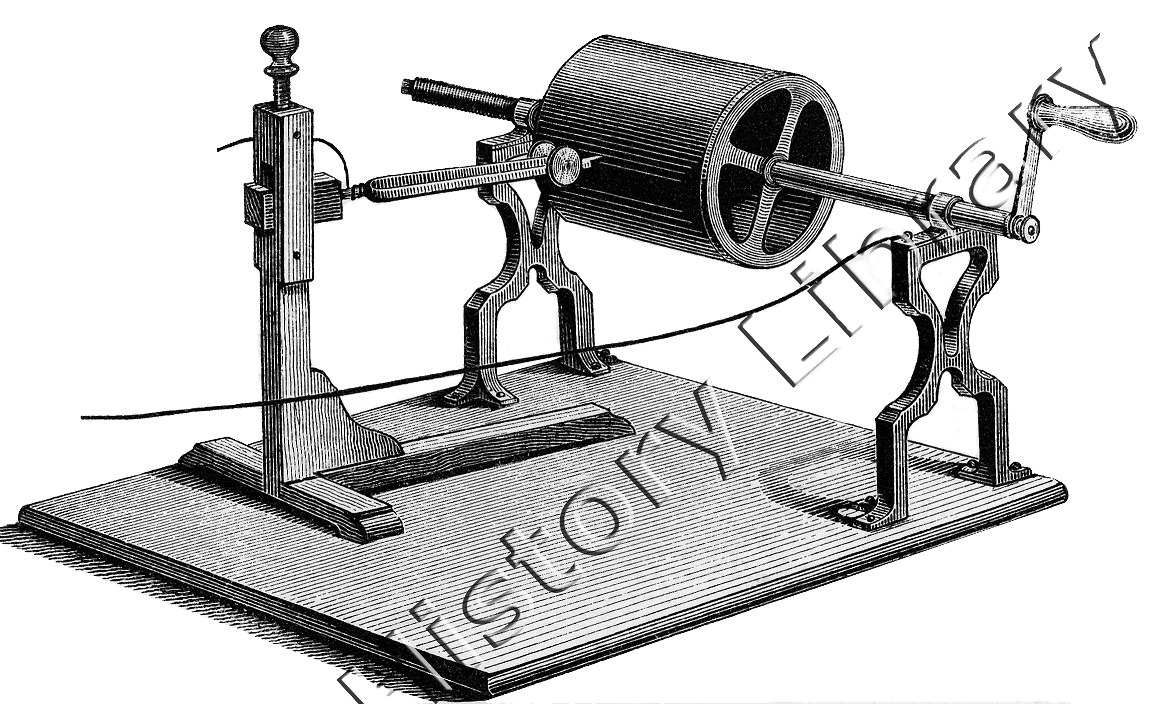
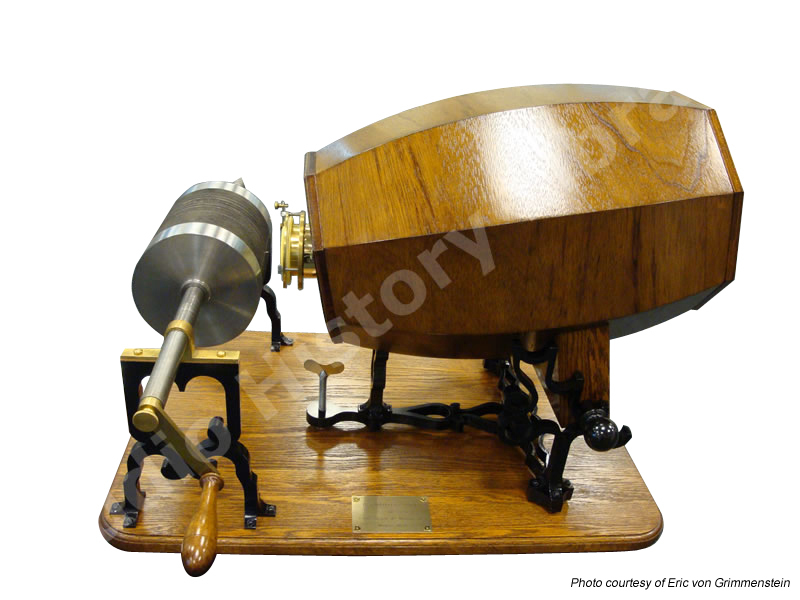
Scott’s device had a
barrel-shaped horn attached to a stylus, which etched sound waves onto sheets
of paper blackened by smoke from an oil lamp. The recordings were not intended
for listening; the idea of audio playback had not been conceived. Rather, Scott
sought to create a paper record of human speech that could later be deciphered.
But the Lawrence
Berkeley scientists used optical imaging and a “virtual stylus” on
high-resolution scans of the phonautogram, deploying
modern technology to extract sound from patterns inscribed on the
soot-blackened paper almost a century and a half ago. The scientists belong to
an informal collaborative called First Sounds that also includes audio
historians and sound engineers.
David Giovannoni, an American audio historian who led the
research effort, will present the findings and play the recording in public on
Friday at the annual conference of the Association for Recorded Sound
Collections at Stanford University
in Palo Alto, Calif.
Scott’s 1860 phonautogram was made 17 years before Edison received a
patent for the phonograph and 28 years before an Edison associate captured a
snippet of a Handel oratorio on a wax cylinder, a recording that until now was
widely regarded by experts as the oldest that could be played back.
Mr. Giovannoni’s
presentation on Friday will showcase additional Scott phonautograms
discovered in Paris, including recordings made in 1853 and 1854. Those first
experiments included attempts to capture the sounds of a human voice and a
guitar, but Scott’s machine was at that time imperfectly calibrated.
“We got the early phonautograms to squawk, that’s about it,” Mr. Giovannoni said.
But the April 1860 phonautogram is more than a squawk. On a digital copy of
the recording provided to The New York Times, the anonymous vocalist, probably
female, can be heard against a hissing, crackling background din. The voice,
muffled but audible, sings, “Au clair de la lune, Pierrot répondit”
in a lilting 11-note melody — a ghostly tune, drifting out of the sonic murk.
The hunt for this audio holy grail was begun in the fall by Mr. Giovannoni
and three associates: Patrick Feaster, an expert in the history of the
phonograph who teaches at Indiana University,
and Richard Martin and Meagan Hennessey, owners of Archeophone
Records, a label specializing in early sound recordings. They had collaborated
on the Archeophone album “Actionable Offenses,” a
collection of obscene 19th-century records that received two Grammy
nominations. When Mr. Giovannoni raised the
possibility of compiling an anthology of the world’s oldest recorded sounds,
Mr. Feaster suggested they go digging for Scott’s phonautograms.
Historians have long
been aware of Scott’s work. But the American researchers believe they are the
first to make a concerted search for Scott’s phonautograms
or attempt to play them back.
In December Mr. Giovannoni and a research assistant traveled to a patent
office in Paris, the Institut National de la Propriété Industrielle. There he
found recordings from 1857 and 1859 that were included by Scott in his phonautograph patent application. Mr. Giovannoni
said that he worked with the archive staff there to make high-resolution,
preservation-grade digital scans of these recordings.
A trail of clues,
including a cryptic reference in Scott’s writings to phonautogram
deposits made at “the Academy,” led the researchers to another Paris
institution, the French Academy of Sciences, where several more of Scott’s
recordings were stored. Mr. Giovannoni said that his
eureka moment came when he laid eyes on the April 1860 phonautogram,
an immaculately preserved sheet of rag paper 9 inches by 25 inches.
Skip to
next paragraph
Audio: 1860 recording:
 The Phonautograph Recording from 1860 of 'Au Clair de la Lune'
1931:
An
Audio Excerpt from a 1931 Recording of the Same Song
Related Topic Pages:
“It was pristine,” Mr. Giovannoni
said. “The sound waves were remarkably clear and clean.”
His scans were sent to
the Lawrence Berkeley lab, where they were converted into sound by the
scientists Carl Haber and Earl Cornell. They used a technology developed
several years ago in collaboration with the Library of Congress, in which
high-resolution “maps” of grooved records are played on a computer using a
digital stylus. The 1860 phonautogram was separated
into 16 tracks, which Mr. Giovannoni, Mr. Feaster and
Mr. Martin meticulously stitched back together, making adjustments for
variations in the speed of Scott’s hand-cranked recording.
Listeners are now left
to ponder the oddity of hearing a recording made before the idea of audio
playback was even imagined.
“There is a yawning
epistemic gap between us and Léon Scott, because he
thought that the way one gets to the truth of sound is by looking at it,” said
Jonathan Sterne, a professor at McGill University in
Montreal and the author of “The Audible Past: Cultural Origins of Sound
Reproduction.”
Scott is in many ways an
unlikely hero of recorded sound. Born in Paris in 1817, he was a man of
letters, not a scientist, who worked in the printing trade and as a librarian.
He published a book on the history of shorthand, and evidently viewed sound
recording as an extension of stenography. In a self-published memoir in 1878,
he railed against Edison for “appropriating” his methods and misconstruing the
purpose of recording technology. The goal, Scott argued, was not sound
reproduction, but “writing speech, which is what the word phonograph means.”
In fact, Edison arrived
at his advances on his own. There is no evidence that Edison drew on knowledge
of Scott’s work to create his phonograph, and he retains the distinction of
being the first to reproduce sound.
“Edison is not
diminished whatsoever by this discovery,” Mr. Giovannoni
said.
Paul Israel, director of
the Thomas A. Edison Papers at Rutgers University in Piscataway, N.J.,
praised the discovery as a “tremendous achievement,” but called Edison’s
phonograph a more significant technological feat.
“What made Edison
different from Scott was that he was trying to reproduce sound and he
succeeded,” Mr. Israel said.
But history is finally
catching up with Scott.
Mr. Sterne, the McGill
professor, said: “We are in a period that is more similar to the 1860s than the
1880s. With computers, there is an unprecedented visualization of sound.”
The acclaim Scott sought
may turn out to have been assured by the very sonic reproduction he disdained.
And it took a group of American researchers to rescue Scott’s work from the
musty vaults of his home city. In his memoir, Scott scorned his American rival
Edison and made brazen appeals to French nationalism. “What are the rights of
the discoverer versus the improver?” he wrote less than a year before his death
in 1879. “Come, Parisians, don’t let them take our prize.”